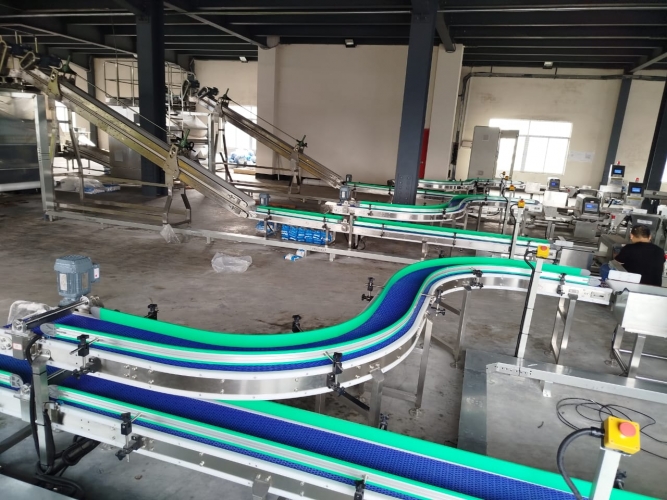
Modular Belt Conveyor System
A belt conveyor system is a highly efficient and reliable mechanical transport system used to move materials, goods, or products across various distances within a facility. It consists of a continuous loop of a belt made from materials such as rubber, PVC, or fabric, supported by rollers or pulleys. The belt is driven by a motor and is commonly used in industries such as manufacturing, logistics, mining, food processing, and warehouses. Belt conveyors are ideal for transporting a wide range of items, from small packages to bulk materials, over both short and long distances. They offer smooth, continuous movement, improve workflow efficiency, reduce manual labor, and are highly customizable in terms of speed, length, and incline to suit specific operational needs.

| Varieties of Modular Belt Conveyors | Plastic Modular Belt Conveyor | Metal Modular Belt Conveyor | Cleated Modular Belt Conveyor |
| Curve Modular Belt Conveyor | Incline/Decline Modular Belt Conveyor | Sanitary Modular Belt Conveyor | |
| Specification | Value |
|---|---|
| Belt Material | Plastic: polypropylene (PP), polyethylene (PE), or polyvinyl chloride (PVC) Metal: Stainless steel or galvanized steel is often used for heavy-duty applications, especially in high-temperatu |
| Belt Width | 50 mm to 1,200 mm (but can be customized depending on application) |
| Belt Pitch (Module Size) | Standard Pitch: 12.7 mm to 100 mm, with 19.05 mm, 25 mm, and 38 mm being some of the most common sizes |
| Load Capacity | Light Duty: Up to 50 kg per meter. Medium Duty: Up to 150-500 kg per meter. Heavy Duty: Can handle up to 1,000 kg per meter or more, depending on the design and the type of belt used. |
| Speed | Standard Range: between 0.3 m/s to 1.5 m/s, |
| Roller Diameter | Standard Range: 38 mm and 150 mm, depending on the load and application |
| Frame Material | Steel: For general applications, often coated or galvanized. Stainless Steel: Used in environments requiring resistance to corrosion, such as in food processing or chemical industries. 304/31 |
| Belt Surface Type | Flat Surface Cleated Surface: Raised Edge: Mesh or Perforated |
| Incline/Decline Angle | Standard Range: Up to 30° incline |
| Belt Construction | interlocking modules, which can be replaced individually if damaged. Module Material: Polypropylene, Polyethylene, Stainless Steel, Metal, etc. |
| Drive System | Motorized Pulley External Drive Sumitomo,SEW, Teco. Others China brand |
| Cleaning and Sanitation | Easy to Clean: Modular belts are designed for easy cleaning and sanitization, with features like open construction and smooth surfaces. Sanitary Design: Common in food, beverage, and pharmace |
| Customization Options: | Curved Sections: Modular belts can be designed for curved conveyors, facilitating smooth changes in direction. Variable Lengths: Conveyor lengths can be tailored based on the application. Acc |
A belt conveyor system is a highly efficient and reliable mechanical transport system used to move materials, goods, or products across various distances within a facility. It consists of a continuous loop of a belt made from materials such as rubber, PVC, or fabric, supported by rollers or pulleys. The belt is driven by a motor and is commonly used in industries such as manufacturing, logistics, mining, food processing, and warehouses. Belt conveyors are ideal for transporting a wide range of items, from small packages to bulk materials, over both short and long distances. They offer smooth, continuous movement, improve workflow efficiency, reduce manual labor, and are highly customizable in terms of speed, length, and incline to suit specific operational needs.
Industrial Goods

Pharmaceutical industry

Flour Industries

Sugar Industries

Salt Industries

| Name | Document |
|---|---|
| Picture | Download |